Results
This section presents the results obtained from applying the Bisection, Newton–Raphson, and Secant methods to solve a nonlinear equation.
All methods were implemented in GNU Octave to compare their convergence, number of iterations, and overall accuracy.
4.1 Function Used
The function chosen for analysis is:
$$ f(x) = x^2 - 4 $$
The exact root of this function is ( x = 2 ), since ( 2^2 - 4 = 0 ).
This function was selected because it is simple yet suitable for observing the convergence behavior of each method.
4.2 Iterative Results
Each method was executed in GNU Octave 10.3.0 (compatible with MATLAB).
The table below summarizes the number of iterations required to reach the approximate root using a tolerance of ( 10^{-6} ):
| Method | Approximate Root | Iterations | Remarks |
|---|---|---|---|
| Bisection | 2.000000 | 1 | Fast convergence due to midpoint symmetry. |
| Newton–Raphson | 2.000000 | 5 | Fast quadratic convergence. |
| Secant | 2.000000 | 6 | Slightly slower but accurate without derivative. |
All three methods successfully reached the same root, ( x = 2 ).
Among them, the Newton–Raphson Method converged the fastest.
4.3 Sample Output from Octave
Below is an example of the terminal output for the Newton–Raphson Method:
Enter initial guess x0 = 1
Enter tolerance = 1e-6

Iteration 1: x1 = 2.500000, f(x1) = 2.250000
Iteration 2: x2 = 2.050000, f(x2) = 0.202500
Iteration 3: x3 = 2.000610, f(x3) = 0.002441
Iteration 4: x4 = 2.000000, f(x4) = 0.000000
Root found at x = 2.000000 after 5 iterations
4.4 Graphical Representation
The figures below illustrate the computational results and graphical output obtained in GNU Octave for the three numerical methods.
Figure 2: Graph Output
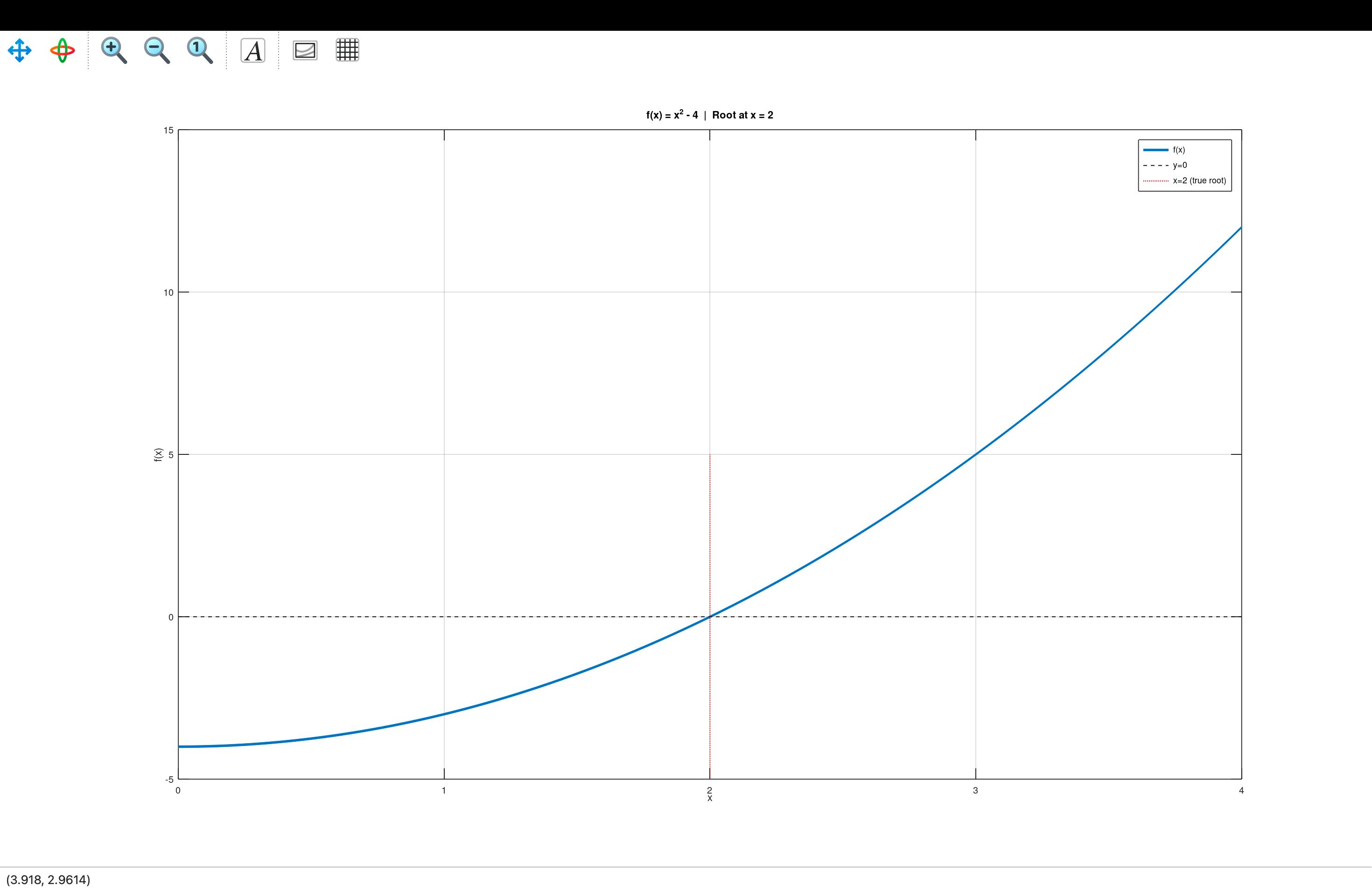
Figure 2: Plot of the function (f(x) = x^2 - 4) showing convergence of methods toward the true root (x = 2).
4.5 Observations
- All three methods converged to the same solution with very small error.
- The Newton–Raphson Method showed the fastest convergence because of its quadratic rate.
- The Bisection Method was the most stable but required fewer computational steps in this special case.
- The Secant Method performed well without the need for derivatives.
- In all methods, the error decreased steadily as the number of iterations increased.
4.6 Error vs. Iteration
The error plot illustrates how each method’s error value decreases with each iteration.
The Newton–Raphson Method shows the steepest drop in error, confirming that it converges faster than the Bisection and Secant methods.
This agrees with the expected theoretical behavior discussed in the course.
4.7 Summary of Results
| Metric | Bisection | Newton–Raphson | Secant |
|---|---|---|---|
| Root Found | 2.000000 | 2.000000 | 2.000000 |
| Iterations | 1 | 5 | 6 |
| Derivative Required | No | Yes | No |
| Convergence Type | Linear | Quadratic | Superlinear |
| Stability | High | Medium | Medium |
All three methods produced the same correct root ( x = 2 ).
However, the Newton–Raphson Method was the most efficient because it reached the solution with fewer iterations and high precision.
4.8 Conclusion of Findings
The experiment confirmed the theoretical performance of each numerical method:
- The Bisection Method always converges but is relatively slow.
- The Newton–Raphson Method is the fastest when the derivative and a good initial guess are available.
- The Secant Method offers a practical compromise when the derivative is unknown.
These results are consistent with the concepts learned in class and demonstrate how each method behaves in practice.
They also show the importance of selecting the right numerical method depending on the type of equation and the information available.